Decorating with William Morris Without Looking Traditional
William Morris designs have been loved for more than 150 years, but that doesn’t mean they belong only in traditional interiors.
With their intricate botanical patterns, rich colours and unmistakable Arts & Crafts character, William Morris fabrics can look surprisingly fresh in a contemporary home. The secret is often how you use them.
Rather than filling a room with pattern, a carefully chosen William Morris lampshade, cushion or accent piece can introduce colour, character and a sense of craftsmanship without making your home feel old-fashioned.
Here are some of my favourite ways to bring William Morris into a modern interior.
1. Let One William Morris Piece Be the Focus
One of the easiest ways to use William Morris in a contemporary room is to avoid trying to match everything.
Instead, choose one statement piece.
A William Morris lampshade on a simple lamp base can become a beautiful focal point against neutral walls and understated furniture. Designs such as Pimpernel, Strawberry Thief, Honeysuckle and Golden Lily have enough detail to command attention without needing lots of other pattern around them.
The same principle works with cushions. One or two patterned cushions on a plain sofa can completely change the character of the room.
The contrast between an intricate heritage print and a simple modern interior is often what makes it work.
2. Pair Heritage Pattern with Contemporary Furniture
William Morris doesn’t have to mean dark wood, antiques and traditional furniture.
Try combining Morris patterns with:
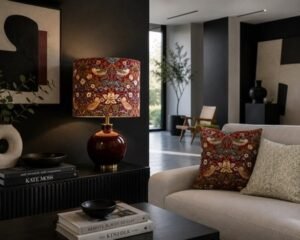
- clean-lined contemporary sofas
- simple wooden furniture
- modern glass or ceramic lamp bases
- painted furniture
- natural linen and cotton
- contemporary artwork
A richly patterned lampshade sitting on a simple modern base can feel completely different from the same fabric used in a heavily traditional room.
It’s the mix of old and new that keeps the look interesting.
3. Use Colour Rather Than Period Style as Your Starting Point
Instead of asking, “Does William Morris go with my room?”, look at the individual colours within the pattern.
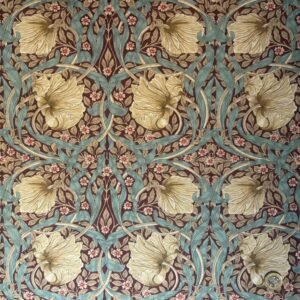
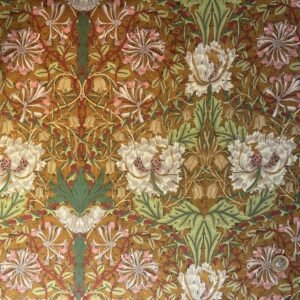
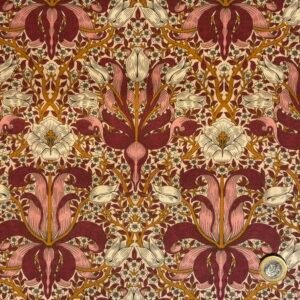
Many Morris designs contain wonderful combinations of greens, blues, reds, ochres and soft neutrals.
Choose one or two of those colours and repeat them elsewhere in the room.
For example, a William Morris lampshade containing sage green might be paired with a green velvet chair, painted side table or a few simple cushions.
You don’t need everything to match. Repeating just one colour is often enough to make the room feel considered.
4. Don’t Be Afraid of Bold Colour
William Morris himself certainly wasn’t afraid of colour.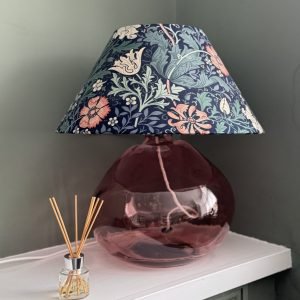
Although some of his designs are available in muted, traditional colourways, others work beautifully in bright and contemporary interiors.
A colourful Morris lampshade can look fantastic against a strong wall colour, particularly when the rest of the room is relatively simple.
Deep blue, forest green, terracotta and even pink can all provide striking backdrops for Morris designs.
If you love colour, there is no reason to restrict yourself to beige walls simply because you’re introducing a heritage print.
5. Mix William Morris with Modern Patterns
Pattern mixing doesn’t have to make a room feel busy.
The trick is to vary the scale.
The detailed botanical pattern of a Morris design can work beautifully alongside something much simpler, such as a stripe, check or small geometric pattern.
For example, you might combine a William Morris lampshade with a striped cushion or a simple checked throw.
Keeping a common colour running through the different patterns helps everything sit comfortably together.
6. Use William Morris in Unexpected Places
You don’t need to wallpaper an entire room to enjoy William Morris.
Smaller touches can have just as much impact. 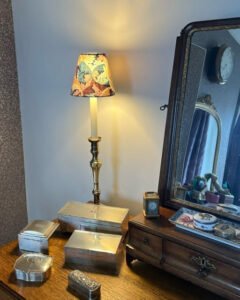
A lampshade beside the bed, a pair of shades on console lamps, cushions on an otherwise simple sofa or even a small candle-clip shade can introduce the pattern without dominating the space.
Lighting is particularly useful because it naturally draws the eye. A beautiful patterned shade can become almost like a piece of artwork within a room.
7. Think Beyond the Country Cottage
William Morris is often associated with cottages and traditional English interiors, but his designs can work in many different settings.
They can look equally at home in:
- colourful eclectic interiors
- contemporary apartments
- Victorian and Edwardian houses
- modern country homes
- maximalist schemes
- simple neutral spaces
It’s less about the age of your home and more about the pieces you choose to put together.
8. Choose the Right William Morris Design for Your Style
Not every Morris design creates the same feeling.
If you prefer a softer look, choose a design with a lighter background or more restrained colour palette.
For something dramatic, look for deeper colours and larger botanical patterns.
And if you love maximalism, embrace the detail. A statement lampshade paired with colourful artwork, cushions and collected pieces can create a wonderfully individual room.
There really isn’t one “correct” way to decorate with William Morris.
Heritage Design for Modern Homes
Perhaps that’s why William Morris designs have endured for so long.
The patterns may have been created in the nineteenth century, but their inspiration — flowers, foliage, birds and the natural world — doesn’t date.
Used alongside contemporary furniture, modern colours and pieces you genuinely love, William Morris can feel every bit as relevant today as it did when the designs were first created.
At Fait par Moi, I handmake William Morris lampshades and cushions in a wide selection of designs, shapes and sizes. My products are made to order, so you can choose something that works specifically with your room rather than designing your room around the lampshade.
And if you have a particular colour, size, shape or William Morris design in mind, bespoke commissionsare always welcome.
If you are unsure what size of lampshade to choose, check out my blog “How to choose the right lampshade size“.